


We may not all agree on how fast things will change or who it will benefit first, but we had one prominent alignment this year, consistent for everyone on the team:
In 2025, we saw Los Angeles on fire at the same time we were confirming 2024 as the world’s hottest year on record. Pope Francis died the day after a visit from JD Vance. The first fatal crash of a Boeing 787 Dreamliner occurred 40 seconds after takeoff. ICE raided major cities across the US while Los Angeles transitioned from on-fire to on-protest against mass deportation. Central Texas experienced one of the most catastrophic flash floods in history. The Russian coast saw the sixth-largest earthquake ever recorded. Charlie Kirk was assassinated. And TARIFF was the most prolific word in US media, having been used a grand total of 621,118 times.
We might have made that last one up. But is this the end of a year or the end of the world?
Thankfully, it wasn’t all doom and gloom. We humans flawlessly landed the first commercial spacecraft on the moon. A two-time Olympic gold medalist from Zimbabwe was elected as the 10th President of the International Olympic Committee, becoming the first woman and the first African to lead the organization in its 130-year history. Renewable energy surpassed coal usage for the first time ever. And Green Sea Turtles are officially no longer endangered thanks to ongoing conservation efforts since the 1970s. Now that’s persistence.
And we’ll take any wins we can get.
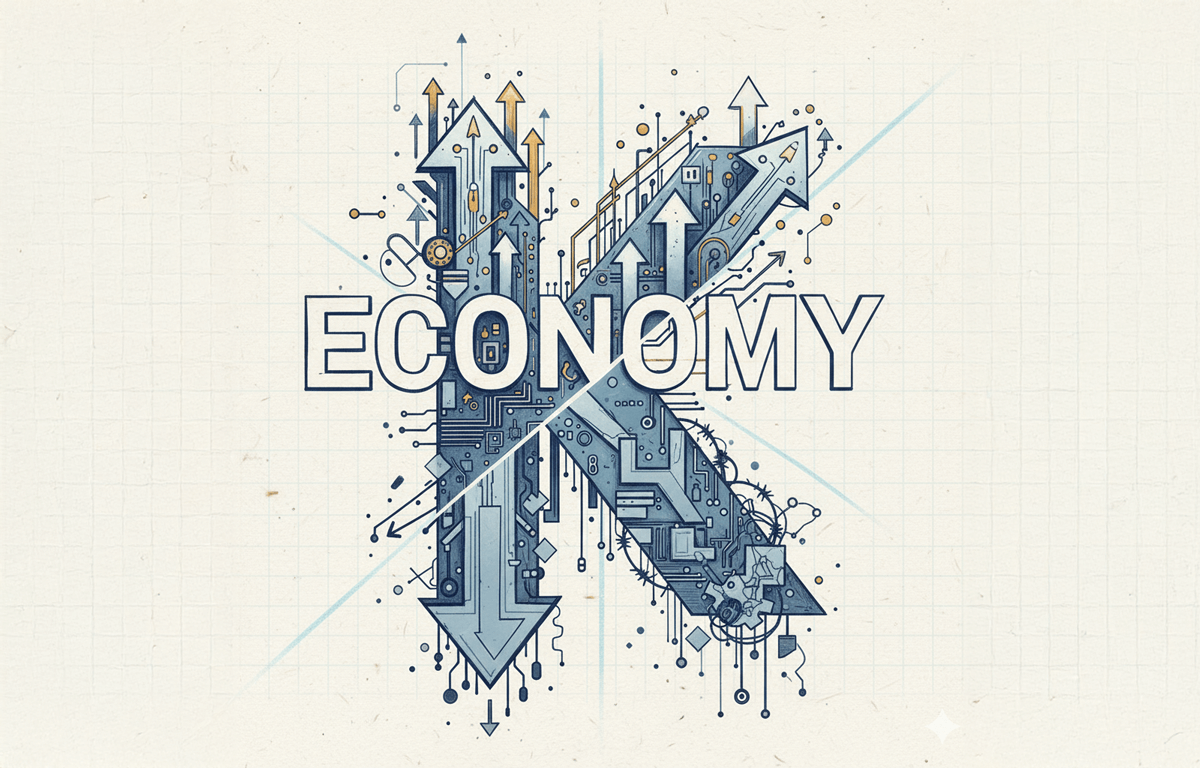
One of the clearest patterns this year was the conflict of progress vs. stagnation. We faced a year of economic uncertainty, and the dividing line which increasingly runs between those who can work fluently with AI and those who cannot (or choose not to). And, those who can afford knowledge and technology, and those who cannot.
We’re eyeing the growth of a K-shaped economy, where one segment continues to accelerate while another struggles to keep pace. The divide is already visible in hiring, wage pressure, and career mobility, and it’s unlikely to smooth itself out anytime soon.
The entertainment industry is feeling the strain with corporate mergers and 41% percent of 2025 consumer sentiment claiming streaming subscriptions aren’t worth the price, and almost half (47%) saying they pay too much right now.
That’s a considerable amount of fluctuation in questionable revenue for every streaming service.
Online, we see creators of all ages who once relied on revenue from content platforms like YouTube and social media now fragmenting across more channels. From brand sponsors on Instagram and Vine reviews on Amazon, to being paid one-to-one by fans via Patreon, Beehiiv, and Substack.
It all shows enough interest to pay for more personalized subscriptions in exchange for entertainment, knowledge, and content beyond those platforms.
Prediction: As knowledge gaps fragment and monetization becomes harder for businesses and creators to sustain, the creator economy will continue to divide in the near term.
And it may be heading toward a period of consolidation that could include new platforms or updates to existing ones that consolidate subscriptions by providing access to multiple creators, much as Spotify, MasterClass, Netflix, and other predecessors are already doing at scale.
The question is: How will we meet in the middle where everybody wins?
No longer just a soft skill, adaptability is the unspoken hiring trait now critical to operations.
New tools are arriving faster than most teams can evaluate them (nothing new), which continues increasing tension and initial resistance. If resistance isn’t quickly followed by inevitable adoption, employees will be left in the lower half of an expanding K-shaped economy.
As AI adoption becomes the baseline expectation for nearly every industry, those who remain on top of the tech will be better positioned to respond to further change. But who has the time?
For adaptability to occur, learning must be championed. With the pace of AI development, the pressure is on individuals to learn as much as possible in their spare time, but even more importance will be placed on employers to invest in training protocols and professional development.
Prediction: Companies that focus on Career Development will outpace competitors in the long term. Hiring will become even more competitive in the short term, and for companies, "teach a person to fish" may become more common by default with educational incentives.
For individuals, the interview process will rely more and more on methods to validate a person’s adaptability before hiring takes place. And for business, proposal processes may rely on similar validation means. This could lead to longer hiring periods and stricter guidelines that (hopefully) decrease churn and faulty hires.
Structured workflows, planning buffers, and repeatable production processes are foundational for teams managing multiple projects at scale. And how many people or teams do you know that are working on just a single project these days?
The operational AI solutions market is on a tear and only continuing to grow. Which is no surprise when speed without structure tends to collapse under its own weight. This is where we see a lot of startups stall unless they can manage operations as well as product development.
Once new tools shift from novelty to infrastructure, they compound value. Whether B2B, D2C, or otherwise, we’re all in the same boat here, and this boat can’t steer itself (yet). We all benefit from structure, regardless of the tools, to achieve scalable growth at a faster pace.
Prediction: In the near term, operational infrastructure will rise in focus and cost, while creating a larger and more segmented ops-software ecosystem.
That means more subscriptions or custom app development that solves specific combinations of operational efficiencies for each type of business. Software engineers will continue to be highly sought after in the near term.

Even with the rate of accelerating technology, we find moments of real impact still come at least as much from alignment of human craft combined with real direction, and if luck has it, perfect timing. Therein lies the holy trinity.
At Culture Pilot, we’ve found that “lightning in a bottle” outcomes are difficult to achieve without creative strategy and execution actively shaping the work regardless of the level of AI involvement in the process. Which means testing, failing, and continuing the learning cycle as rapidly as possible, is a foundational process.
And that process traditionally requires more time, which means we’re forced to either 1) adapt to faster production or 2) prove value in longer timelines.
All the while, it’s an emotionally difficult daily regime for anyone to put something out into the world knowing failure to some degree is almost always anticipated.
Resilience is no longer separate from professional capabilities. With the acceleration of change comes the acceleration of the learning process. This has become so commonplace in the decades leading up to now that it’s now fully baked into operations, and the ability to “manage under the pressure of condensed timelines” has become an unspoken expectation of every job role.
So we’re left with an obvious emotional strain on everyone, from interns to executive leadership, for how most companies in the public and private sectors make decisions and sustain output. It’s no wonder that over half the country is stressed over job insecurity.
Prediction: The mental health segment (real and synthetic) will continue to thrive for the foreseeable future.
We’re witnessing AI commerce moving quickly from concept to infrastructure. Shopping research and purchasing are increasingly embedding themselves directly into conversational chat. From brand awareness and discovery to customer acquisition, it’s impacting every part of the marketing funnel, all the way to the retention experience.
That requires a lot of trust, another commodity that becomes harder to achieve in an environment where AI-generated content continues to raise questions about authenticity and intent.
We’re facing this irony of our desire (and dependency) on AI accuracy, versus our lack of trust in its results (hallucinations and slop) and its ability to produce results faster.
We want to believe AI search results are summarizing correctly. Or deep-research mode is pulling data from accurate sources. Or vibe coding is using the most efficient methods. Or image, video, and sound generation will produce accurate results.
But it all takes extra time to validate the results of a technology still in its infancy.
Provided the act of “AI production + human validation and fine-tuning” helps us achieve faster or more profitable results than human input alone, it’s still an added step of the process with no clear timeline for when it will phase itself out.
Prediction: The first company, AI or otherwise, that can confidently solve the majority of trust barriers, will leapfrog into pole position. And then be immediately acquired if not already one of the few key players.
AI clearly expands what individuals and small teams can accomplish, but the K-shaped economy shows how it also accelerates inequality and the fear of forced retirement.
The narrative around “AI employees” and fully automated companies is no longer subtle, and job displacement is already affecting creative, administrative, and support roles. This concern mirrors broader labor projections that show, on average, workers can expect that two-fifths (that’s nearly 40%) of existing skill sets will be transformed or become outdated over the 2025-2030 period.
Unless incentives shift around the practice of replacing humans with AI solutions in big business, that fear will continue to be warranted. And with it will come more and more common (read: bland) results.
As creatives, we see a lack of judgment and originality everywhere, all the time. And yet, we also see how our AI collaborative tension produces stronger outcomes within our industry when we have access to tools that allow us to continue our capitalistic endeavours, whatever they may be.
Prediction: Reducing human involvement may increase short-term efficiency, but it risks unpredictable long-term loss and a predictable, unfortunate lack of originality. There are no clear answers on this one yet.
When we look at the top side of the K-shaped economy, it’s made up of those with the time and resources to spend learning the infinite amount of new tools that are becoming so easily accessible. They can afford to experiment, fail, and learn the tools becoming embedded across industries.
The downside we’re already seeing is a landscape saturated with questionable output, where the origin of the content may gain more value even if it continues to impact displacement. When systems optimize relentlessly for efficiency, people tend to push back.
And we see it everywhere from slow food movements to a backlash on fast-fashion and ongoing appreciation for handmade works from television commercials to museum collections.
Prediction: We’re watching for a cultural counter-movement in which corners of the internet intentionally restrict AI-generated content, and human-made work becomes more desirable and exclusive, while third places continue to thrive in the post pandemic world.
A lot has happened in the past year, and so much more is on the way. We’re currently fighting the gaps between capabilities and trust, while readiness without alignment continues to amplify any existing imperfections.
All signs point to a very familiar challenge; technology continues to move rapidly, and humans continue to respond unevenly.
To put it another way, we’re drawing the roadmaps while driving down side streets at 120mph alongside a surge in adolescent drivers convinced they know the quickest routes.
Sound scary?
It is.
But in the end, at least for now, direction matters more than speed.
Just don’t be the one who’s afraid to ask for directions.
We’ll be here to navigate when you’re ready.

