


by Tim DeSilva
Culture Pilot turned 23 this month, and if you’re reading this, there’s a pretty good chance you’re already part of the story I’m about to tell.
For 23 years (and now counting quite literally), Culture Pilot has worked with an extraordinary collection of people, businesses, organizations, and creative minds. We’ve helped launch brands, reposition businesses, build campaigns, navigate unpredictable challenges, and turn ambitious ideas into something real.
Some of those relationships lasted months. Others have lasted decades. And somewhere along the way, we accumulated more history than we knew how to explain.
Which is a slightly embarrassing problem for a firm that helps other organizations communicate what makes them valuable.

Over the years, I’ve lost count of how many times a prospective client has asked whether we’ve worked in a particular industry, solved a specific problem, or built something similar to what they’re imagining. Often, the answer is yes. And even more often it’s complicated because everything we do is fairly bespoke.
Over time, we struggle to recall everything we’ve done, much less communicate the breadth of that experience or its limits.
Our website does a decent job at the relatively recent highlight reel, but it still does what most company websites do: present a carefully curated picture.
Decades don’t fit neatly into a handful of case studies. And case studies don’t do justice to the bigger picture. It’s an accumulation of serendipity. Of people. And the relationships, decisions, experiments, successes, failures, and collaborations that improve the ability to turn ideas into reality.
None of it happens alone.
Every chapter of Culture Pilot’s history exists because someone placed their trust in us. Clients trusted us with their businesses and ambitions. Talented colleagues trusted us with their careers. Partners brought their expertise and challenged our thinking.
In more than two decades, we’ve watched organizations and technologies evolve, brands change hands, businesses close, and entire industries disappear. Some of the work we’re still proud of is no longer visible anywhere. The people, ideas, and effort behind it were real, but the evidence sometimes fades away.
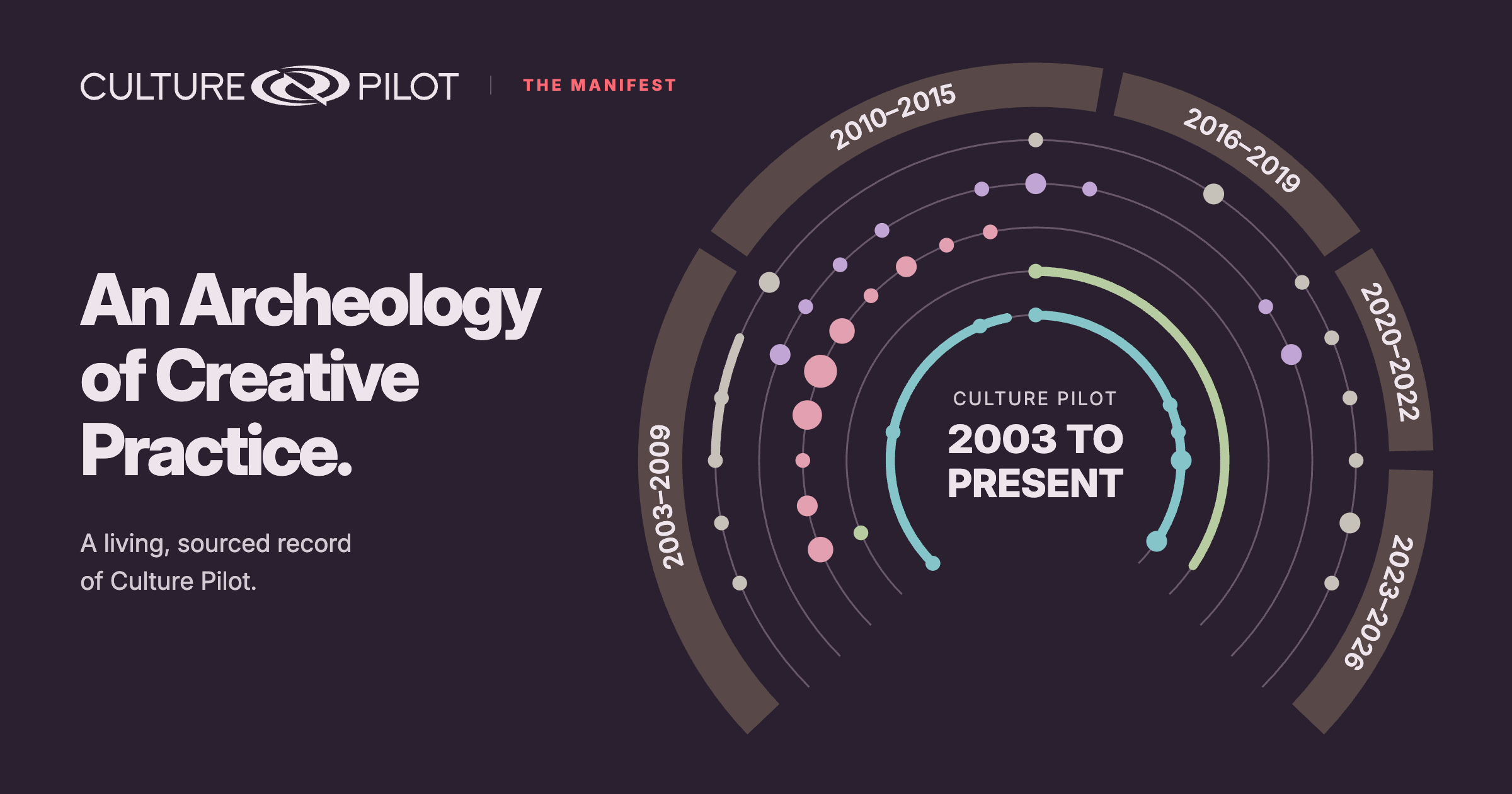
In the spring, we began developing a beta version of what is now the Culture Pilot Manifest. What started as an internal wiki gradually became a bigger experiment. It’s a public, interconnected, and continually evolving archive of our firm’s history, work, people, clients, industries, and relationships.
It’s not a replacement for culturepilot.com. And it’s far from another portfolio. Instead of selecting a few projects to represent our experience, we’re documenting the bigger picture, and we’re making the connections explorable.
But hey. We’re designers and creative thinkers. We can’t have 23 years of data just end up in a glorified spreadsheet.
We’re building this as a navigable visual archive where you can follow a project to the organizations or collaborators behind it, discover people involved, explore industries, and uncover relationships between seemingly unrelated chapters of our history.
Some records represent major brand builds. Others document smaller contributions to something much larger. All of them help tell the Culture Pilot story and recognize those involved.
From the very beginning of our company’s history, we’ve invested time in emerging tech and how it can expand what a creative firm can do. The Manifest is one tangible result of that investment and curiosity.
Much of the information comes directly from our own records, invoicing systems, CRMs, project archives, emails, and web hosting history. We’ve also supplemented our own recollection with something important: external sources, whenever possible.
Just the ability to research, organize, connect, and present an enormous amount of institutional knowledge would have been prohibitively difficult to assemble not long ago. More recent AI advancements in 2026 (the same ones that have helped us build support staff) and the internal groundwork we’ve laid in AI over the past few years have allowed us to connect the data.
Researching, organizing, and connecting this much institutional knowledge would have been prohibitive just a few years ago. But the groundwork we’ve laid in emerging tech, the systems we’ve built over the past several years, particularly in AI, combined with the rapid advancements in 2026, have made it possible to bring all of this information together for the first time.
We’ve worked hard to make this accurate, but we know there will be omissions, imperfect details, and connections we haven’t yet discovered. So we’ve also included a way for partners, clients, and the broader community to submit corrections, suggest additions, and request changes or removals. The historical record will become even more accurate as more people contribute sources of truth.
We don’t expect this approach of documenting organizational history to remain unusual for long. We’d be surprised if it did. The opportunity to make decades of institutional knowledge accessible, connected, and useful is too important to ignore.
For me, it’s how uniquely personal it all is. Beyond the tech, the design, the nostalgia, or the experience it represents, it’s unique because of the people. And that goes well beyond Culture Pilot to anyone else looking to do the same.
For us, it’s the colleagues who helped build this firm, the clients who believed in an idea before it existed, the collaborators who made the work better, the partners who’ve helped carry it forward, and the countless individuals whose contributions, large and small, are woven into our history.
Perhaps other organizations will take inspiration from ours. Some will copy the idea, no doubt. Perhaps they’ll build something better. I hope they do because we all have much more to learn.
The Manifest is a record of Culture Pilot, and it belongs to everyone who helped make it possible.
Explore the Culture Pilot Manifest. Look for your organization, yourself, or a project we worked on together. If something is missing, please tell us. If someone deserves credit, help us recognize them. If we’ve gotten something wrong, help us make it right.
As of this writing, only ~37% of the first 419 records are fully documented. We still have work to do.
Be curious with us. If you’re not part of the story yet, there’s always room in the next chapter.

